 Login
Login



Board-approved · PACE Provider · CE Broker auto-reporting · Instant certificate
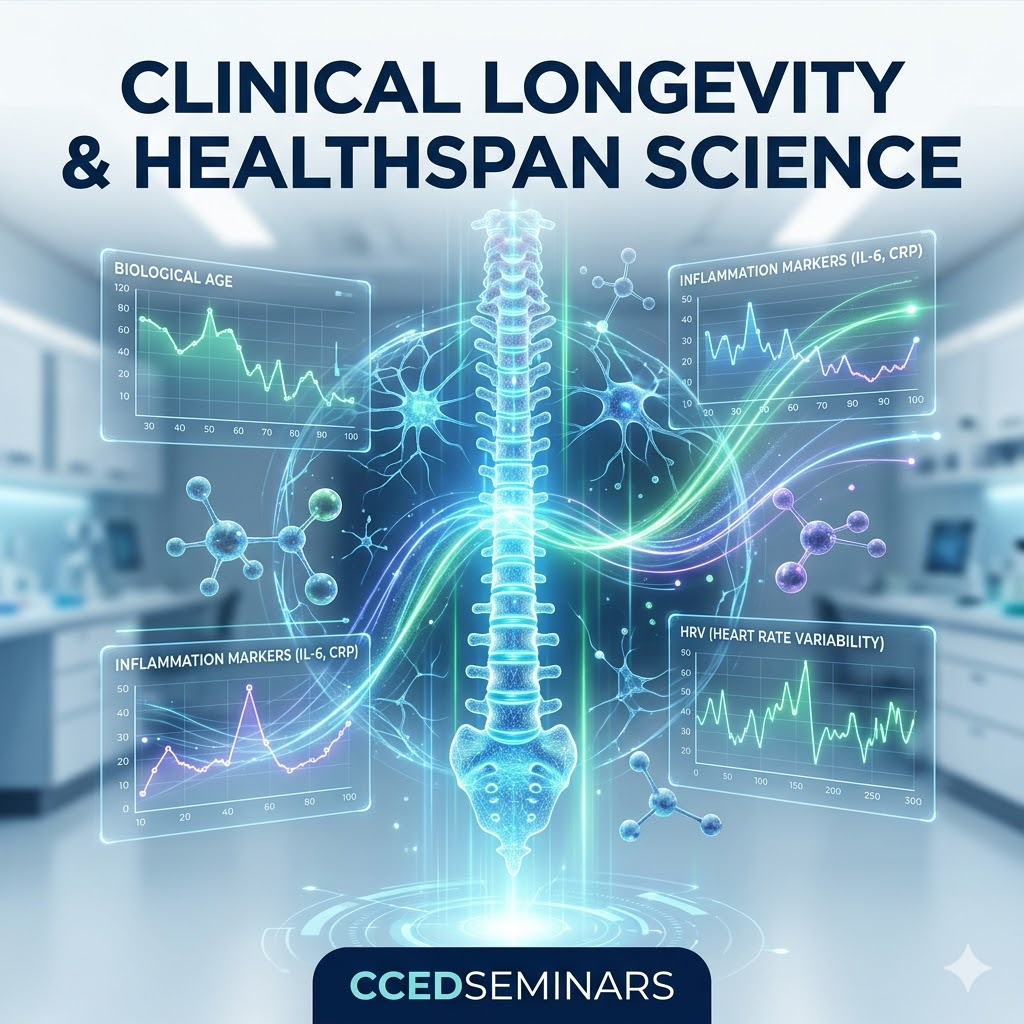 | PACE-Approved CE Track · Five Pillars Clinical Longevity & Healthspan SciencePACE-approved chiropractic CE that brings evidence-based longevity medicine into your practice — movement, nutrition, sleep, emotional health, and biochemical optimization. Every pillar sits squarely within chiropractic scope. |
At a glance
Format Live webinars + on-demand | Audience Licensed DCs | Approval PACE, Boards, TBCE | Certificate Instant, in your account |
Approval & Renewal Facts at a Glance
According to the official FCLB PACE Provider Search, CCEDseminars is recognized as PACE Provider. Texas chiropractors should confirm the 6-hour live and 10-hour online split published in the Texas Board of Chiropractic Examiners CE rules. CE Broker auto-reporting is performed by CCEDseminars automatically with course completion per PACE & Propelus CE Broker licensee policy.
The Five Pillars of Clinical Longevity & Healthspan Science
Each pillar carries its own literature lens, its chiropractic-integration bridge, and the clinical tools we teach. Together they form the curriculum that drives every course in this category. Tap any pillar to expand.
+ Pillar 1 — Movement
VO2 max and skeletal-muscle mass are the strongest predictors of all-cause mortality (Mandsager 2018; Fraser 2024).
Chiropractic integration: Joint mechanoreception inhibits nociception and down-regulates sympathetic tone, linking mechanical integrity to neuro-metabolic vitality.
? Zone 2 training for mitochondrial biogenesis
? High-intensity intervals for VO2 max
? Resistance protocols for sarcopenia and osteopenia
+ Pillar 2 — Nutrition
Food is epigenetic information. Metabolic flexibility and glucose variability outrank caloric restriction (Keshet 2023; Stokes 2018).
Chiropractic integration: Metabolic endotoxemia drives the low-grade neuro-inflammation that frequently presents as chronic musculoskeletal pain (Cani 2007).
? Continuous glucose monitor (CGM) interpretation
? Protein dosing at 1.6–2.2 g/kg for body recomposition
? Elimination protocols for intestinal-barrier integrity
+ Pillar 3 — Sleep
Slow-wave and REM sleep drive glymphatic clearance of beta-amyloid and tau (Iliff 2012; Xie 2013).
Chiropractic integration: A sympathetically dominant patient cannot hold an adjustment, recover from micro-trauma, or modulate TNF-alpha / IL-6 cytokines.
? Circadian biology and blue-light mitigation
? Sleep-hygiene protocols
? Oura, WHOOP, and Apple Watch interpretation
+ Pillar 4 — Emotional Health & Stress
Chronic stress shortens telomeres and accelerates cellular aging (Epel 2004; Lin 2022).
Chiropractic integration: Chiropractic has always focused on tone. Stress regulation introduces the parasympathetic brake via vagal mechanisms.
? HRV as a clinical proxy for autonomic resilience
? Down-regulation: box breathing, somatic tracking, Tai Chi
? Behavior-change mechanics
+ Pillar 5 — Biochemical Optimization
Longevity science evaluates pharmaceuticals, validated nutraceuticals, and regenerative molecules (Barzilai 2016; Deichmann 2010).
Chiropractic integration: The DC is an evidence-based filter for patients flooded with social-media longevity claims — including statin–CoQ10 interactions and creatine, NAD+, and peptide claims.
? De-prescribing and drug-nutrient interactions
? Evidence-based nutraceuticals (creatine, HMB, berberine)
? Emerging molecules (peptides, NAD+ precursors, BPC-157)
Within Chiropractic Scope — the Peer-Reviewed Proof
Prevention, wellness counseling, lifestyle medicine, and nutritional guidance are documented within established DC scope. These four references anchor PACE-defensibility for every course in this category.
- Fikar PE, Edlund KA, Newell D (2015). Current preventative and health promotional care offered to patients by chiropractors in the United Kingdom: a survey. Chiropractic & Manual Therapies, 23(1). doi:10.1186/s12998-015-0053-z
- Johnson C, Green BN (2009). Public Health, Wellness, Prevention, and Health Promotion: Considering the Role of Chiropractic and Determinants of Health. J Manipulative Physiol Ther, 32(6):405–412. doi:10.1016/j.jmpt.2009.07.001
- Lee MK, Amorin-Woods L, Cascioli V, Adams J (2018). The use of nutritional guidance within chiropractic patient management: a survey of 333 chiropractors from the ACORN practice-based research network. Chiropractic & Manual Therapies, 26(1). doi:10.1186/s12998-018-0175-1
- Lin AFC, Cunliffe C, Chu VK, et al. (2023). Prevention-Focused Care: The Potential Role of Chiropractors in Hong Kong’s Primary Healthcare Transformation. Cureus, 15(3). doi:10.7759/cureus.36950
The ACA Longevity Mandate
The ACA Code of Ethics charges doctors of chiropractic to collaborate with other healthcare professionals with the goal of “increasing the longevity of the U.S. population.”
Longevity is not a scope expansion for chiropractors — it is a professional mandate.
CLHS coursework operationalizes that mandate. Every pillar maps to a modifiable driver of healthspan documented in peer-reviewed literature and is delivered within established chiropractic scope.
CLHS hours are PACE-approved and apply toward chiropractic license renewal in every PACE-recognized jurisdiction — including Texas (TBCE), Florida, Georgia, and most U.S. states. Check your state →
Frequently Asked Questions
Tap any question to expand.
+ Is longevity within chiropractic scope of practice?
Yes. The American Chiropractic Association’s Code of Ethics explicitly calls for DCs to work toward “increasing the longevity of the U.S. population.” Chiropractic’s non-pharmacological toolkit — spinal manipulation, lifestyle counseling, nutritional guidance, HRV assessment, and movement preservation — aligns directly with the evidence-based pillars of healthspan extension.
+ What is healthspan science for chiropractors?
Healthspan science is the study of maximizing the years a person lives in good health, free from chronic disease and disability. For chiropractors, it provides a clinical framework that connects spinal and nervous system health to the biological drivers of aging.
+ Where can chiropractors get continuing education on continuous glucose monitors (CGMs)?
CCEDseminars’ Clinical Longevity & Healthspan Science category is the only PACE-approved chiropractic CE source covering CGM interpretation as a longevity tool.
+ What is the best longevity continuing education for chiropractors?
The best longevity CE for chiropractors combines evidence-based aging science with clinical tools that fall within chiropractic scope of practice. Look for PACE-approved programs that cover healthspan biology, HRV and autonomic function, allostatic load, metabolic monitoring, and wearable data interpretation.
+ How can chiropractors integrate HRV into clinical practice?
Chiropractors can integrate heart rate variability (HRV) as an objective measure of autonomic nervous system function — before and after adjustments, across care plans, and as a longevity tracking tool.
+ Are there longevity certifications for chiropractors?
The field is nascent. CCEDseminars’ Clinical Longevity & Healthspan Science category is the foundation for the first PACE-approved longevity certification track for DCs.
Pillar Literature — the Peer-Reviewed Foundation
Pillar 1 · Movement
- Mandsager K, et al. (2018). JAMA Network Open.
- Fraser BJ, et al. (2024). British Journal of Sports Medicine.
- Frontera WR, Ochala J. (2015). Calcified Tissue International.
Pillar 2 · Nutrition
- Keshet A, et al. (2023). Cell Metabolism.
- Stokes T, et al. (2018). Nutrients.
- Cani PD, et al. (2007). Diabetes.
Pillar 3 · Sleep
- Iliff JJ, et al. (2012). Science Translational Medicine.
- Xie L, et al. (2013). Science.
- Robbins R, et al. (2024). Sensors.
Pillar 4 · Emotional Health & Stress
- Epel ES, et al. (2004). PNAS.
- Lin J, Epel E. (2022). Ageing Research Reviews.
- Shaffer F, Ginsberg JP. (2017). Frontiers in Public Health.
Pillar 5 · Biochemical Optimization
- Deichmann R, et al. (2010). Ochsner Journal.
- Barzilai N, et al. (2016). Cell Metabolism.
- Forbes SC, et al. (2022). Nutrients.
- Gwyer D, et al. (2019). Cell and Tissue Research.
Related Resources
Reviewed by Monte Horne, DC · Last reviewed: June 30, 2026 · PACE Provider #34015544 · Reviewed monthly.
Browse Clinical Longevity & Healthspan Science courses
All courses below are PACE-approved and reportable to CE Broker on completion.