
The Chiropractic Exit Strategy: Solving the 2026 Opioid Dilemma with Resolution Pharmacology
Must see video: YouTube
A landmark study published in BMJ Open has provided our most powerful data point to date: Patients with new low back pain who saw a chiropractor first had roughly 90% decreased odds of early opioid use compared to those who started care with a primary-care physician.
This isn't just a win for the profession; it’s a mandate. When we are the point of first contact, we aren't just treating back pain—we are preventing addiction before it begins.
Legislators and federal agencies are moving toward a "Non-Opioid First" standard of care that DCs must navigate:
"Chiropractic isn't just a shield; it's about giving patients a non-opioid future."
Traditional pain management often focuses on suppressing inflammation (blocking COX-2). However, Specialized Pro-Resolving Mediators (SPMs), such as Resolvins, act as endogenous lipid mediators that orchestrate the resolution of inflammation rather than merely blunting the signal.
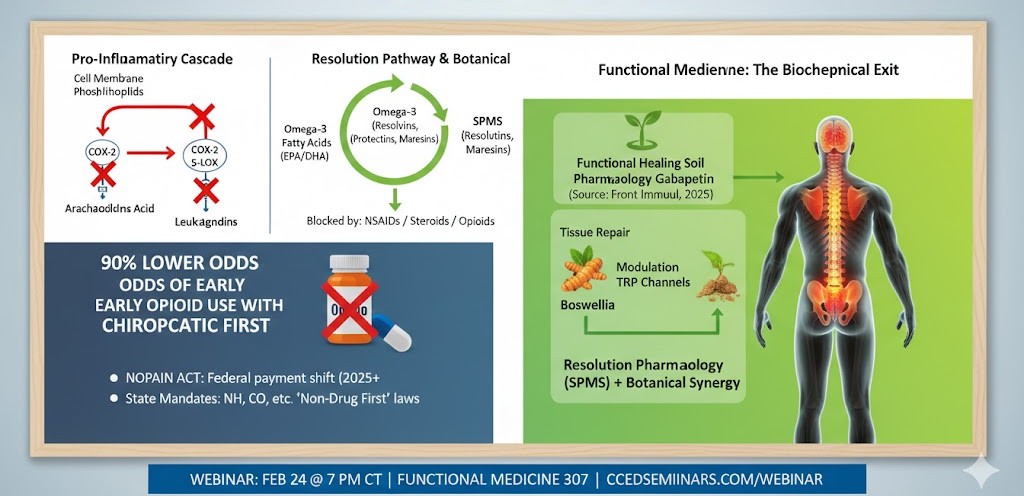
According to a 2025 Frontiers in Immunology review, Resolvin-class SPMs have demonstrated the ability to normalize glial activation and reverse mechanical hyperalgesia. In several preclinical models, these pro-resolving mediators actually outperformed gabapentin in alleviating neuropathic pain—without the side effects of central nervous system depression.
While SPMs manage the "Resolution Phase," targeted botanicals like Curcumin and Boswellia manage the upstream inflammatory drive. By modulating NF-κB and 5-LOX pathways, these botanicals lessen the metabolic load on the body, allowing pro-resolving pathways to dominate. This multi-target protocol is the hallmark of a high-level Functional Medicine practice.
Functional Medicine 307: Natural Pain Management & The Non-Opioid Directive
Master the clinical application of SPMs, botanical synergy, and the 2026 regulatory shift in this 2-hour live event.
REGISTER FOR THE WEBINARNote: This course is eligible for 2 hours of Chiropractic Continuing Education credit in most jurisdictions. Visit our YouTube channel for clinical previews of this session.
 Login
Login