 Login


Home › Physical Examination CE Courses › Physical Examination 205: Cervical Spine
At a Glance
| Course: | Physical Examination 205: Cervical Spine · 2 CE hours · $40 |
| Faculty: | Donald Ozello, DC, CCN, CCSM |
| Format: | Online, on-demand — start immediately |
| Pricing: | $40 ($20/hr) · automatic bundle discounts |
| Approval: | PACE Provider #34015544 · TCC co-sponsored |


PACE Provider #34015544 · Co-sponsored by Texas Chiropractic College · Completions reported to CE Broker
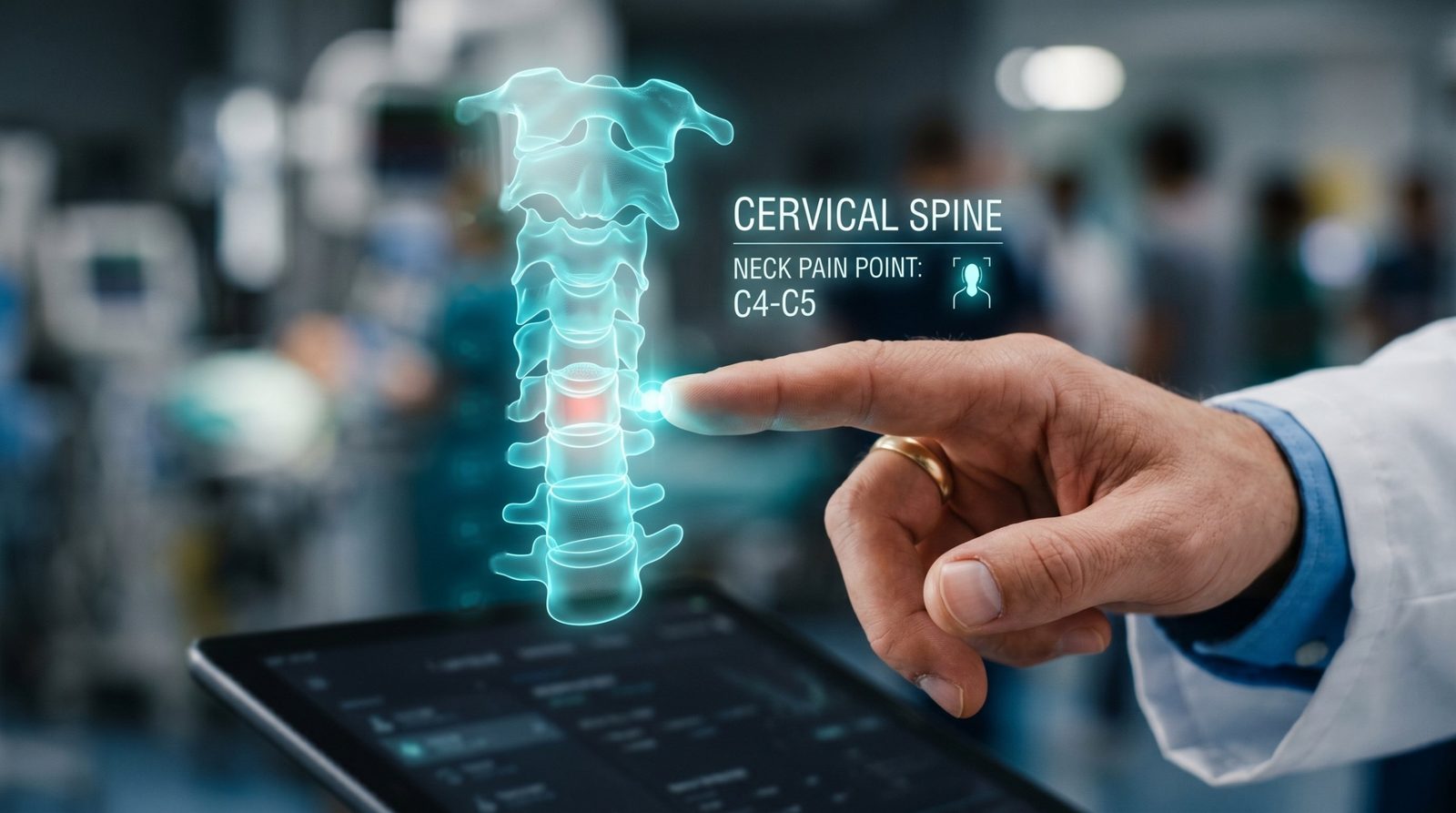
The cervical examination is a sequence, and the sequence is the skill: history, observation, palpation, the neurological screen, range of motion, then the orthopedic tests that confirm — in that order, every time. Physical Examination 205 is the two-hour course that walks the sequence step by step, with the key tests demonstrated on video. Dr. Donald Ozello opens with the nerve-root patterns of cervical disc herniation from C2 to T1, then builds the examination from the consultation up: history, mechanism, distribution and questionnaires; visual assessment of posture, movement, breathing and antalgic position; palpation of the cervical and thoracic muscles, chest, shoulders and upper extremities; and the radicular evaluation that belongs in every exam. The neurological screen follows with the grading scales a chiropractor is expected to document — muscle strength 0 to 5, the myotomes C1 through T1, the dermatomes C5 through T2, and the biceps, brachioradialis and triceps reflexes graded 0 to 5.
Range of motion is taught three ways — active, passive seated and supine, and resisted in three positions — with the symptom-reporting routine that turns a motion into a finding, plus the Janda cervical flexion movement pattern test. Then the orthopedic tests, each with position, procedure, positive finding and what it indicates: Rust's sign, cervical compression, flexion compression, Spurling, maximal foraminal compression, shoulder depression, cervical distraction, the shoulder abduction test and Bakody's sign for radiculopathy and disc herniation; the deep cervical flexor strength test; Hoffman's and L'hermitte's signs for cervical myelopathy; the cervical flexion-rotation, head-neck differentiation and smooth pursuit neck torsion tests for a cervicogenic source of head symptoms; and the Romberg test. It closes with imaging — radiographs, CT and MRI. The course is the procedural companion to Dr. O'Hara's Physical Examination 202, which covers the same region from the injury-pattern and imaging side.
Where This Course Fits — The Physical Examination Series
The CCEDseminars Physical Examination series is the on-demand catalog for the examination skills a chiropractor uses every day. New titles are released as faculty complete them, and there is no bundle in this category: each course is taken on its own, and the multi-course discount applies automatically in the cart when the hours add up.
Neurological Examination
Physical Examination 201: Current Concepts in Pupillometry (Michael Hall, DC, FIACN · 2 CE · $40)
Regional Orthopedic Examination — you are here
Physical Examination 202: Neck and Upper Extremities (Dennis O'Hara, DC, DACBSP · 2 CE · $40)
Physical Examination 203: Lumbar Spine and Lower Extremity (Dennis O'Hara, DC, DACBSP · 2 CE · $40)
Physical Examination 205: Cervical Spine — this course (Donald Ozello, DC, CCN, CCSM · 2 CE · $40)
Vascular Risk Screening
Physical Examination 204: Cerebral and Vascular Risks (John H. Riggs III, MBA, DC, DIANM · 2 CE · $40)
The current series, with pricing, lives on the Physical Examination category page.
What You'll Learn
On completing Physical Examination 205 you will be able to:
- Recognize the typical examination findings of a solitary cervical nerve root lesion from disc herniation at C2 through T1, and conduct the cervical consultation — history, mechanism, symptom description and distribution, prior episodes, questionnaires and visual analog scores
- Perform the visual examination (posture, movement, breathing, antalgic position, stabilization), palpation of the cervical and thoracic spine muscles, chest, shoulders and upper extremities, and the radicular evaluation of both extremities
- Perform and grade the neurological screen: muscle strength testing on the 0–5 scale, the myotomes C1–C2 through T1, the dermatomes C5 through T2, and the biceps, brachioradialis and triceps deep tendon reflexes on the 0–5 scale
- Assess cervical range of motion actively, passively (seated and supine) and against resistance in three positions, with the symptom-reporting routine, and perform the Janda cervical flexion movement pattern test for upper cross syndrome
- Perform and interpret the cervical orthopedic tests — Rust's sign, cervical compression and flexion compression, Spurling, maximal foraminal compression, shoulder depression, cervical distraction, shoulder abduction and Bakody's sign; the deep cervical flexor strength test; Hoffman's and L'hermitte's signs; the cervical flexion-rotation, head-neck differentiation and smooth pursuit neck torsion tests; and the Romberg test — and select imaging (radiographs, CT, MRI)
Course Outline
- Cervical Disc Herniation — typical examination findings of a solitary nerve root lesion by level: C2, C3–C4, C5, C6, C7, C8 and T1
- Consultation — history, description and distribution of symptoms, questionnaires and visual analog scores; mechanism, area of symptoms, prior episodes; the purpose of the physical examination
- Examination — visual (posture, movement, breathing, antalgic position, stabilization); palpation of the cervical and thoracic spine muscles, chest, shoulders and upper extremities, joint dysfunction; radicular symptoms — the meticulous bilateral extremity evaluation every exam should include
- Neurological Screen — muscle strength grades 0–5; myotomes (C1–C2 cervical flexion, C3 lateral flexion, C4 shoulder elevation, C5 shoulder abduction, C6 elbow flexion/wrist extension, C7 elbow extension/wrist flexion, C8 thumb extension/ulnar deviation, T1 hand intrinsics) on video; dermatomes (C5 lateral arm and forearm, C6 thumb, C7 third finger, C8 fifth finger, T1 medial forearm, T2 medial upper arm) on video; deep tendon reflexes graded 0–5 — biceps and brachioradialis C5–C6, triceps C7–C8
- Range of Motion — grading from 0 to 5 with the plus and minus grades; active cervical range of motion with the symptom-reporting routine; passive range of motion seated and supine; resisted range of motion in neutral, early range and near end range; the Janda cervical flexion movement pattern test (sternocleidomastoid dominance and upper cross syndrome) on video
- Orthopedic Tests for Radiculopathy and Disc Herniation — Rust's sign (instability); cervical compression and flexion compression; Spurling test; maximal foraminal compression; shoulder depression test with its confirmation maneuver; cervical distraction (seated and supine); shoulder abduction test (C6–C8); Bakody's sign — each on video with position, procedure, positive finding and indication
- Deep Cervical Flexors, Myelopathy and Cervicogenic Testing — deep cervical flexor strength test (and the endurance test); Hoffman's sign and L'hermitte's sign for cervical myelopathy; cervical flexion-rotation test, head-neck differentiation (seated cervical rotation) test and smooth pursuit neck torsion test for a cervicogenic source of head symptoms; the Romberg test and what a positive result indicates
- Imaging — radiographs, CT and MRI of the cervical spine
Your Physical Examination Faculty
Donald Ozello, DC, CCN, CCSM — instructor of this course — is a sports chiropractor and the founder of Championship Chiropractic in Las Vegas, Certified Chiropractic Sports Medicine physician, Certified Clinical Nutritionist and NSCA Certified Personal Trainer. He teaches the CCEDseminars Sports Injuries, Athletic Injuries, Rehabilitation, Adjusting & Manual Therapy and Geriatrics series, with an emphasis on practical assessment, injury prevention and movement education. Faculty profile »
Dennis O'Hara, DC, DACBSP — sports medicine — teaches Physical Examination 202: Neck and Upper Extremities, the injury-pattern and imaging companion to this course, and 203: Lumbar Spine and Lower Extremity. Faculty profile »
John H. Riggs III, MBA, DC, DIANM teaches Physical Examination 204: Cerebral and Vascular Risks, the vascular screen before cervical manipulation. Faculty profile »
Michael Hall, DC, FIACN — chiropractic neurologist — teaches Physical Examination 201: Current Concepts in Pupillometry. Faculty profile »
Credit, Reporting & State Rules
Physical Examination 205 is a 2-hour on-demand course. Your completion is recorded electronically when you pass the post-course assessment, and your certificate is issued immediately. Completions are reported to CE Broker for the states CCEDseminars serves.
Boards set their own caps on online hours, and some limit hours by category. Before you plan a block of online hours, confirm your board's current rules on the State/Region CEU Approvals page. Texas licensees can verify provider status through the Texas Board of Chiropractic Examiners.
Approved states for this course are listed at the bottom of this page.
What It Costs — and How to Pay Less
Physical Examination 205 is $40 for 2 CE hours — $20 per hour. Multi-course discounts apply automatically in the cart — 10% on 6–9 hours and 20% on 10 or more — with no promo code to enter.
There is no bundle in the Physical Examination category. 205 is the procedural companion to Dr. O'Hara's 202 Neck and Upper Extremities (2 CE · $40) — the same region from the injury-pattern side — and Dr. Riggs' 204 Cerebral and Vascular Risks (2 CE · $40) is the vascular screen that comes before any of it. The three together are 6 CE hours, which is where the automatic 10% discount starts: $108 instead of $120, with hours combining across any CCEDseminars category in the same cart.
References
- Jones MR, et al. Spurling Test. StatPearls [Internet]. Updated August 8, 2023. ncbi.nlm.nih.gov/books/NBK493152
- Teoli D, et al. Lhermitte Sign. StatPearls [Internet]. Updated July 21, 2023. ncbi.nlm.nih.gov/books/NBK493237
- Shahrokhi M, et al. Neurologic Exam. StatPearls [Internet]. Updated January 16, 2023. ncbi.nlm.nih.gov/books/NBK557589
- Whitman PA, et al. Anatomy, Skin, Dermatomes. StatPearls [Internet]. Updated October 24, 2023. ncbi.nlm.nih.gov/books/NBK535401
- Naqvi U, et al. Muscle Strength Grading. StatPearls [Internet]. Updated April 27, 2025. ncbi.nlm.nih.gov/books/NBK436008
- Sharrak S, et al. Cervical Disc Herniation. StatPearls [Internet]. Updated August 28, 2023. ncbi.nlm.nih.gov/books/NBK546618
- Kuo DT, et al. Cervical Spondylosis. StatPearls [Internet]. Updated May 1, 2023. ncbi.nlm.nih.gov/books/NBK551557
- Touma J, et al. Cervical Myofascial Pain. StatPearls [Internet]. Updated July 3, 2023. ncbi.nlm.nih.gov/books/NBK507825
- Forbes J, et al. Romberg Test. StatPearls [Internet]. Updated August 13, 2023. ncbi.nlm.nih.gov/books/NBK563187
Frequently Asked Questions
What does Physical Examination 205 cover?
The complete cervical spine examination as a chiropractor performs and documents it: the nerve-root patterns of cervical disc herniation from C2 to T1; the consultation and history; visual assessment and palpation; the neurological screen with its grading scales — muscle strength 0–5, myotomes C1–T1, dermatomes C5–T2, deep tendon reflexes 0–5; active, passive and resisted range of motion and the Janda cervical flexion test; the orthopedic tests for radiculopathy and disc herniation (Rust's sign, cervical compression, flexion compression, Spurling, maximal foraminal compression, shoulder depression, distraction, shoulder abduction, Bakody's sign); the deep cervical flexor test; Hoffman's and L'hermitte's signs for myelopathy; the cervical flexion-rotation, head-neck differentiation and smooth pursuit neck torsion tests; the Romberg test; and imaging. The key tests are demonstrated on video.
Who teaches the course, and who is it for?
Donald Ozello, DC, CCN, CCSM — sports chiropractor, founder of Championship Chiropractic in Las Vegas and CCEDseminars faculty for the Sports Injuries, Rehabilitation and Adjusting & Manual Therapy series — teaches the 2-hour course. It is written for Doctors of Chiropractic who want a repeatable, documentable cervical examination: the order of the sequence, the grading scales that belong in the chart, and every orthopedic test with its position, procedure, positive finding and indication.
How can a chiropractor tell a pinched nerve in the neck from a spinal cord problem?
By running both halves of the neurological screen the course teaches. A compressed nerve root — cervical radiculopathy from a disc herniation — shows as weakness in one myotome, altered sensation in one dermatome, a diminished reflex at that level, and arm symptoms that reproduce with compression, Spurling or maximal foraminal compression and ease with distraction or shoulder abduction. A spinal cord problem — cervical myelopathy — shows the opposite reflex pattern, brisk reflexes or clonus, and the upper motor neuron signs the course demonstrates: a positive Hoffman's sign (thumb and index finger flexion when the middle finger's tip is flicked) and L'hermitte's sign (an electric-shock sensation down the spine on neck flexion). The distinction decides whether the patient is adjusted or referred.
How is the course delivered, and how do I earn the CE credit?
Physical Examination 205 is online and on-demand: you start immediately after checkout and work at your own pace. When you pass the post-course assessment your completion is recorded electronically and your certificate is issued right away. CCEDseminars is PACE Provider #34015544 and the course is co-sponsored by Texas Chiropractic College; completions are reported to CE Broker for the states served. Approved states are listed at the bottom of this page, and confirming your own board's requirements remains your responsibility.
How is this different from Physical Examination 202, and what pairs well with it?
Both cover the neck, from different directions. Dr. O'Hara's Physical Examination 202 approaches the neck and upper extremities from the injury side — stable versus unstable cervical injuries, spinal cord syndromes, shoulder, elbow and wrist conditions and their imaging. Physical Examination 205 is the examination procedure itself — the sequence, the grading scales and each orthopedic test demonstrated on video. Many clinicians take both; add Dr. Riggs' Physical Examination 204: Cerebral and Vascular Risks, the vascular screen before cervical manipulation, and the three reach 6 CE hours, where the automatic 10% discount starts ($108 instead of $120). The current series with pricing lives on the category page.
State approval and licensing reminder. CCEDseminars is PACE Provider #34015544. Approved states for this course are listed at the bottom of this page, and board rules on online hours change — confirming your own board's current requirements before you enroll is your responsibility.
Physical Examination 205: Cervical Spine
2 CE hours · $40 · online, on demand · Donald Ozello, DC, CCN, CCSM
CCEDseminars · PACE Provider #34015544 · Reviewed by Monte Horne, DC · Last updated October 22, 2026 (CT)