 Login


Home › Physical Examination CE Courses › Physical Examination 213: The Whiplash Patient
At a Glance
| Course: | Physical Examination 213: The Whiplash Patient · 2 CE hours · $40 |
| Faculty: | Dennis O'Hara, DC, DACBSP |
| Format: | Online, on-demand — start immediately |
| Pricing: | $40 ($20/hr) · automatic bundle discounts |
| Approval: | PACE Provider #34015544 · TCC co-sponsored |



PACE Provider #34015544 · Co-sponsored by Texas Chiropractic College · Completions reported to CE Broker
A rear-end collision, a negative emergency room CT, and a patient who is still dizzy weeks later — the whiplash examination starts where the emergency room left off. Physical Examination 213 is Dr. Dennis O'Hara's two-hour course on examining the whiplash patient: the collision history, the Acute Concussion Evaluation form and its red flags, cranial nerve screening, spinal and extremity evaluation, the Balance Error Scoring System, and the imaging decisions — the cervical series with flexion-extension views, when MRI is indicated, and CT versus MRI, SWI, DTI and NeuroQuant for the brain.
Three rear-end collision cases carry the protocol from the first visit through the radiology reports, DXD motion analysis and AMA Guides impairment ratings to treatment, and the course closes with what to expect at deposition. It sits with his Whiplash 207: Personal Injury Case Management and the whiplash-and-concussion case in Physical Examination 212.
Where This Course Fits — The Physical Examination Series
The CCEDseminars Physical Examination series is the on-demand catalog for the examination skills a chiropractor uses every day. New titles are released as faculty complete them, and there is no bundle in this category: each course is taken on its own, and the multi-course discount applies automatically in the cart when the hours add up.
Neurological Examination
Physical Examination 201: Current Concepts in Pupillometry (Michael Hall, DC, FIACN · 2 CE · $40)
Regional Orthopedic Examination
Physical Examination 202: Neck and Upper Extremities (Dennis O'Hara, DC, DACBSP · 2 CE · $40)
Physical Examination 203: Lumbar Spine and Lower Extremity (Dennis O'Hara, DC, DACBSP · 2 CE · $40)
Physical Examination 205: Cervical Spine (Donald Ozello, DC, CCN, CCSM · 2 CE · $40)
Physical Examination 206: Knee and Lower Leg (Dennis O'Hara, DC, DACBSP · 2 CE · $40)
Physical Examination 207: Thoracic Spine and Rib Cage (Donald Ozello, DC, CCN, CCSM · 2 CE · $40)
Physical Examination 208: Lumbar Spine & Sacroiliac Joints (Donald Ozello, DC, CCN, CCSM · 2 CE · $40)
Physical Examination 209: Shoulder Complex (Donald Ozello, DC, CCN, CCSM · 2 CE · $40)
Physical Examination 210: Upper Extremity (Donald Ozello, DC, CCN, CCSM · 2 CE · $40)
Physical Examination 211: Upper Body Nerve Entrapment (Donald Ozello, DC, CCN, CCSM · 2 CE · $40)
Case-Based Examination — you are here
Physical Examination 212: Clinical Pearls in Uncommon Cases (Dennis O'Hara, DC, DACBSP · 2 CE · $40)
Physical Examination 213: The Whiplash Patient — this course (Dennis O'Hara, DC, DACBSP · 2 CE · $40)
Vascular Risk Screening
Physical Examination 204: Cerebral and Vascular Risks (John H. Riggs III, MBA, DC, DIANM · 2 CE · $40)
The current series, with pricing, lives on the Physical Examination category page.
What You'll Learn
On completing Physical Examination 213 you will be able to:
- Take the collision history that drives the whiplash examination — mechanism, awareness of the impending impact, driver or passenger and seat position, seat belt, body contact inside the vehicle, loss of consciousness, symptom onset, emergency transport and the imaging already performed — and triage neurologic, cervical, thoracolumbar, radiating and TMJ complaints
- Document concussion with the Acute Concussion Evaluation (ACE) form — physical, cognitive, emotional and sleep symptoms on the 0–22 scale, the functional and overall ratings — and recognize the red flags that send a patient to the emergency department and the risk factors for protracted recovery
- Perform the physical examination: cranial nerve screening I–XII, spinal inspection, palpation that names the muscle and side, ranges of motion, cervical compression and distraction, Kemp's, straight leg raise and Yeoman's tests, deep tendon reflexes and sensory testing, and Balance Error Scoring System testing — applying the rule that reproducible radicular signs call for MRI
- Choose and read the imaging: the cervical series with flexion-extension stress views, cervical MRI, CT as first-line imaging in acute head injury (subdural, epidural and subgaleal hematoma) and brain MRI with SWI, DTI and NeuroQuant at six weeks; recognize teardrop and burst fractures, medical subluxation, disc herniation and ligament laxity; and follow DXD Alteration of Motion Segment Integrity quantification to an AMA Guides Fifth Edition whole person impairment
- Build the treatment plan — manual soft tissue therapy, passive modalities, spinal manipulation, the staged concussion rehabilitation protocol and nutritional support — and prepare for deposition as the treating doctor: its purpose, format, preparation and the ethical boundaries of witness preparation
Course Outline
- Whiplash as a Cervical Acceleration/Deceleration Injury — the hyperextension-then-hyperflexion mechanism of the rear-end collision; muscle and ligament strain/sprain; coup and contrecoup forces on the brain; ligament laxity; annular tears and disc herniation; how mechanism dictates the tissues involved
- The History — mechanism of injury, awareness of the impending collision, immediate symptoms, transport to the emergency department, radiologic studies already performed, current symptoms; driver or passenger, front or rear seat, seat belt, body contact with the vehicle, loss of consciousness, when symptoms first appeared; triage of headaches, dizziness, vertigo and balance, neck and back pain, radiating pain, numbness and TMJ pain
- Documenting Concussion with the ACE Form — physical symptoms (headache, nausea, vomiting, balance, dizziness, visual problems, fatigue, light and noise sensitivity, numbness), cognitive symptoms, emotional symptoms, sleep symptoms, exacerbation by physical and cognitive activity, the 0–6 overall rating; red flags (worsening headache, seizures, focal signs, drowsiness, repeated vomiting, slurred speech, confusion, limb weakness or numbness, neck pain, behavioral change, altered consciousness); risk factors for protracted recovery (prior concussion, headache history, ADHD and learning disorders, anxiety and depression, sleep and psychiatric disorders)
- The Physical Examination — cranial nerve testing I–XII step by step; spinal inspection, palpation, ranges of motion and orthopedic testing; neurologic testing where the patient reports numbness or tingling (pain, temperature, light touch) and deep tendon reflexes; documentation that names the specific anatomy and side; extremity evaluation; the Balance Error Scoring System from the SCAT5 — double leg stance, single leg stance on the non-dominant leg, tandem stance
- Imaging the Head — CT as first-line imaging in head injury (spatial resolution, calvarium, hemorrhage, foreign bodies, speed and cost) and its blind spot for diffuse axonal injury; subdural, epidural and subgaleal hematoma; MRI with susceptibility-weighted imaging for microhemorrhage, diffusion tensor imaging for axonal tracts and NeuroQuant volumetrics, ordered six weeks after the accident; the research on NeuroQuant and NeuroGage, brain recovery a year after medical clearance, motor vehicle versus sport concussion in adolescents, and concussion and diffuse axonal injury rates in motor vehicle crashes
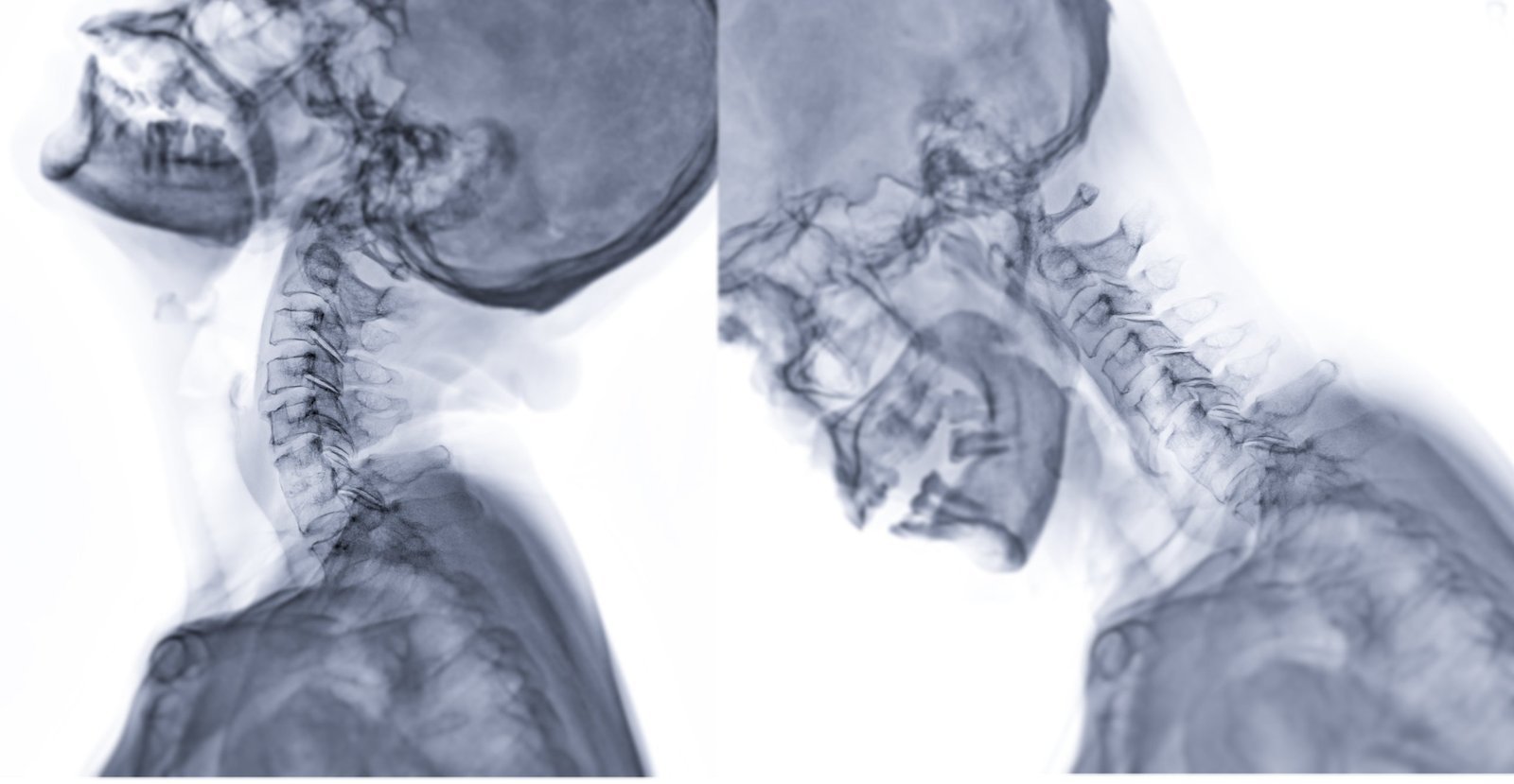
- Neck Injuries — stable and unstable fractures (compressive-flexion teardrop, vertical-compression burst), medical subluxation with ALL and PLL tearing, cervical disc herniation on MRI, ligament laxity on flexion and extension radiographs and the AMA Guides DRE Category IV loss of motion segment integrity (25–28% whole person impairment)
- Case 1 — Male Driver Rear-Ended While Stopped: negative ED CT of head and neck; ACE score 14 of 22 with one prior concussion; cranial nerves, cervical compression and distraction, trapezius, levator and scalene hypertonicity, Kemp's and straight leg raise with posterior thigh radiation; working diagnoses; the cervical series with flexion-extension and the thoracic and lumbar films; C5–6 retrolisthesis on the radiology report; DXD analysis showing translational and angular motion segment compromise and a 19% whole person impairment (2.72 mm ÷ 3.50 × 25%); treatment goals; myofascial release, passive modalities and spinal manipulation; the staged concussion rehabilitation protocol from 24–72 hours of rest to graded physical and cognitive activity and repeat BESS testing; nutritional support
- Case 2 — Female Front-Seat Passenger Rear-Ended at a Light: ACE score 16 of 22 with no prior concussion; cervical films negative on flexion-extension; cervical MRI with posterior central herniations at C4–5 and C5–6, an annular fissure and cord impression with moderate canal stenosis; brain MRI with SWI showing a left frontal hemosiderin focus and DTI showing decreased fractional anisotropy in four of twelve regions (C-FAST score 4); NeuroQuant showing 17 segments of decreased volume (12.05%); DXD angular motion change at C3–4 and a 25% whole person impairment, combined with the herniated discs by the Combined Values Chart; impairment rating in traumatic brain injury; treatment and referral for concussion rehabilitation
- Case 3 — Female Driver Referred from Pain Management: no concussion; neck and back pain with right posterior thigh radiation; cervical films with hypolordosis, anterolisthesis of C3 on C4 worsening in flexion and multilevel listhesis on the stress views; cervical MRI with a C5–6 protrusion and mild central stenosis; normal lumbar MRI; DXD translation of 3.61 mm at C3–4 above the ratable threshold and a 25% whole person impairment; treatment goals, manual therapy, spinal manipulation and rehabilitative exercise
- The Deposition — what a deposition is and its place in discovery; its purposes (facts, theories, your knowledge, what kind of witness you are, locking in opinions); what happens, including depositions by video call; preparation (prior discovery, pleadings, the documents you reviewed, the pre-deposition conference, full candor with your attorney); the ethical limits of witness preparation under the ABA Model Rules — adapted with permission from the expert-witness lectures of Michael W. Mathesie, DC, DACRB, DABFP
Your Physical Examination Faculty
Dennis O'Hara, DC, DACBSP — instructor of this course — is a sports medicine chiropractor, Diplomate of the American Chiropractic Board of Sports Physicians and ACBSP concussion certified, former chiropractor for D.C. United and ringside physician for mixed martial arts. He teaches Physical Examination 202: Neck and Upper Extremities, 203: Lumbar Spine and Lower Extremity, 206: Knee and Lower Leg and 212: Clinical Pearls in Uncommon Cases, and the CCEDseminars Sports Injuries, Whiplash and Case Studies & Clinical Pearls series. Faculty profile »
Donald Ozello, DC, CCN, CCSM — sports chiropractor — teaches Physical Examination 205: Cervical Spine, 207: Thoracic Spine and Rib Cage, 208: Lumbar Spine & Sacroiliac Joints, 209: Shoulder Complex, 210: Upper Extremity and 211: Upper Body Nerve Entrapment. Faculty profile »
John H. Riggs III, MBA, DC, DIANM teaches Physical Examination 204: Cerebral and Vascular Risks, the vascular screen before cervical manipulation. Faculty profile »
Michael Hall, DC, FIACN — chiropractic neurologist — teaches Physical Examination 201: Current Concepts in Pupillometry. Faculty profile »
Credit, Reporting & State Rules
Physical Examination 213 is a 2-hour on-demand course. Your completion is recorded electronically when you pass the post-course assessment, and your certificate is issued immediately. Completions are reported to CE Broker for the states CCEDseminars serves.
Boards set their own caps on online hours, and some limit hours by category. Before you plan a block of online hours, confirm your board's current rules on the State/Region CEU Approvals page. Texas licensees can verify provider status through the Texas Board of Chiropractic Examiners.
Approved states for this course are listed at the bottom of this page.
What It Costs — and How to Pay Less
Physical Examination 213 is $40 for 2 CE hours — $20 per hour. Multi-course discounts apply automatically in the cart — 10% on 6–9 hours and 20% on 10 or more — with no promo code to enter.
There is no bundle in the Physical Examination category. 213 pairs naturally with 212: Clinical Pearls in Uncommon Cases and 202: Neck and Upper Extremities (each 2 CE · $40), and any three of Dr. O'Hara's Physical Examination courses make 6 CE hours, which is where the automatic 10% discount starts: $108 instead of $120. The personal-injury side of the same cases continues in Whiplash 207: Personal Injury Case Management, Whiplash 203: Treatment & Documentation and Whiplash 204: Deposition & Trial Preparation, and the concussion material in Sports Injuries 258: Concussion Update. Hours combine across any CCEDseminars category in the same cart.
References
- Mutch CA, Talbott JF, Gean A. Imaging Evaluation of Acute Traumatic Brain Injury. Neuroimaging Clin N Am. 2018;28(1):43–53. doi:10.1016/j.nic.2017.09.004
- Ross DE, et al. Updated Review of the Evidence Supporting the Medical and Legal Use of NeuroQuant® and NeuroGage® in Patients With Traumatic Brain Injury. Front Hum Neurosci. 2022;16:715807. doi:10.3389/fnhum.2022.715807
- Abnormal asymmetry correlates with abnormal enlargement in a patient with chronic moderate traumatic brain injury. Concussion. 2022;7(1):CNC96. doi:10.2217/cnc-2021-0006
- Churchill NW, Hutchison MG, Graham SJ, Schweizer TA. Mapping brain recovery after concussion: From acute injury to 1 year after medical clearance. Neurology. 2019;93(21):e1980–e1992. doi:10.1212/WNL.0000000000008523
- Differences in Adolescent Symptom Reporting Following Motor Vehicle Accident Versus Sport-Related Concussion. Arch Clin Neuropsychol. 2021;36(4):554–560. doi:10.1093/arclin/acaa086
- Viano DC, Parenteau CS. Concussion, Diffuse Axonal Injury, and AIS4+ Head Injury in Motor Vehicle Crashes. Traffic Inj Prev. 2015;16(8):747–753. doi:10.1080/15389588.2015.1013188
- Zasler ND, Martelli MF, Bender MC. Impairment Rating in Traumatic Brain Injury. AMA Guides Newsletter. 2003;8(5):1–9.
- Centers for Disease Control and Prevention, HEADS UP. Acute Concussion Evaluation (ACE) — Physician/Clinician Office Version. cdc.gov — ACE form
- Echemendia RJ, et al. The Sport Concussion Assessment Tool 5th Edition (SCAT5): Background and rationale. Br J Sports Med. 2017;51(11):848–850. doi:10.1136/bjsports-2017-097506
- Howard Head Sports Medicine. Nutrition for Concussion Recovery: Fueling the Brain. howardhead.org — Nutrition for concussion recovery
- American Medical Association. Guides to the Evaluation of Permanent Impairment, 5th Edition (Errata). Chicago: AMA Press; 2001.
- Yochum TR, Rowe LJ. Essentials of Skeletal Radiology, 3rd Edition. Philadelphia: Lippincott Williams & Wilkins; 2005.
Frequently Asked Questions
What does Physical Examination 213 cover?
The examination of the patient who presents after a motor vehicle collision, from the first question to the deposition. It opens with whiplash as a cervical acceleration/deceleration injury and the history that drives everything after it — mechanism, awareness of the impact, seat position, seat belt, body contact, loss of consciousness, symptom onset and what the emergency department already imaged. Concussion is documented with the Acute Concussion Evaluation form, its red flags and the risk factors for a protracted recovery. The physical examination covers cranial nerve screening I–XII, spinal and extremity evaluation with the orthopedic and neurologic tests, documentation that names the anatomy and side, and the Balance Error Scoring System. Imaging covers CT as first-line in acute head injury, the hematomas it finds, brain MRI with SWI, DTI and NeuroQuant at six weeks, the cervical series with flexion-extension views, MRI when radicular signs are reproducible, fractures, subluxation, disc herniation and ligament laxity, and DXD motion analysis with AMA Guides impairment ratings. Three rear-end collision cases carry the protocol through radiology reports, impairment ratings and treatment, and the course closes with deposition.
Who teaches the course, and who is it for?
Dennis O'Hara, DC, DACBSP — sports medicine chiropractor, Diplomate of the American Chiropractic Board of Sports Physicians, ACBSP concussion certified, former chiropractor for D.C. United and MMA ringside physician — teaches the 2-hour course. It is written for Doctors of Chiropractic who see collision patients: the first-visit examination, the documentation that will be read by an attorney, the imaging to order and when, and the treatment plan that follows.
What imaging should a chiropractor order after a whiplash injury?
The course's answer is in two parts, the neck and the head. For the neck, a cervical series with flexion and extension stress views — the neutral films in all three cases were read as unremarkable for alignment, and it was the stress views and the DXD motion analysis that showed the ligament laxity: interruptions of George's line, translational and angular alteration of motion segment integrity, and in two of the three patients a listhesis that appeared or worsened in flexion or extension. Reproducible radicular signs on the examination are the indication for cervical MRI; in the second case it found posterior central herniations at C4–5 and C5–6 with an annular fissure and cord impression, which the emergency CT had not shown. For the head, CT is the right first-line study in the acute setting because it is fast and sensitive for skull fracture and hemorrhage, but it lacks sensitivity for diffuse axonal injury, the most common injury in concussion. When concussion symptoms persist, brain MRI with susceptibility-weighted imaging, diffusion tensor imaging and NeuroQuant volumetrics is ordered about six weeks after the accident; in the second case the standard MRI was grossly unremarkable while SWI showed a frontal microhemorrhage, DTI showed decreased fractional anisotropy in four of twelve regions and NeuroQuant showed decreased volume in 17 segments.
How is the course delivered, and how do I earn the CE credit?
Physical Examination 213 is online and on-demand: you start immediately after checkout and work at your own pace. When you pass the post-course assessment your completion is recorded electronically and your certificate is issued right away. CCEDseminars is PACE Provider #34015544 and the course is co-sponsored by Texas Chiropractic College; completions are reported to CE Broker for the states served. Approved states are listed at the bottom of this page, and confirming your own board's requirements remains your responsibility.
What pairs well with Physical Examination 213?
Physical Examination 212: Clinical Pearls in Uncommon Cases, whose fourth case is a rear-end collision with whiplash and concussion, and Physical Examination 202: Neck and Upper Extremities for the cervical examination itself — any three of Dr. O'Hara's Physical Examination courses are 6 CE hours, where the automatic 10% multi-course discount starts ($108 instead of $120). The personal-injury side continues in his Whiplash 207: Personal Injury Case Management, Whiplash 203: Treatment & Documentation and Whiplash 204: Deposition & Trial Preparation, and the concussion material in Sports Injuries 258: Concussion Update. New Physical Examination titles are released as faculty complete them; the current list with pricing lives on the category page.
State approval and licensing reminder. CCEDseminars is PACE Provider #34015544. Approved states for this course are listed at the bottom of this page, and board rules on online hours change — confirming your own board's current requirements before you enroll is your responsibility.
Physical Examination 213: The Whiplash Patient
2 CE hours · $40 · online, on demand · Dennis O'Hara, DC, DACBSP
CCEDseminars · PACE Provider #34015544 · Reviewed by Monte Horne, DC · Last updated October 28, 2026 (CT)